


Timing the Market is Futile
Timing your participation in markets is a fool’s errand. A reliance on headlines, a hunch, patterns, a “system”, or emotional choices all risk working against long-term investor success. There has been virtually no one who has ever consistently entered and exited markets to maximize returns over extended time periods.
It’s also interesting to see how the best and worst market days often clump together, and how many of the biggest fluctuation days can run counter to a current trend. When market declines occur, it’s important to remember why you are investing, and the time that remains to meet your goals. Normal market volatility is the “price of admission” for the superior returns that equities can provide; you can’t meet long-term goals with short-term thinking.
It makes sense to build your portfolio to match your ability to prudently stay the course. This is a critical element of long-term investing success. Portfolio additions during a temporary decline may, in fact, actually speed the recovery process.

How Interest Rate Changes Affect Bond Prices
Besides a borrower’s credit quality, shifting interest rates can also produce market price fluctuation before a bond reaches its maturity date. These specific price changes are fairly easily-measured when you understand the impact of interest rate changes on bond values.
Think of the relationship between bond prices and interest rates like a see-saw. Prices move inversely to interest rate shifts, falling as interest rates rise and vice-versa. These impacts are also affected by the remaining period before a bond matures. Longer-term bond values tend to be more sensitive to interest rate moves, while shorter maturity bonds are less affected.
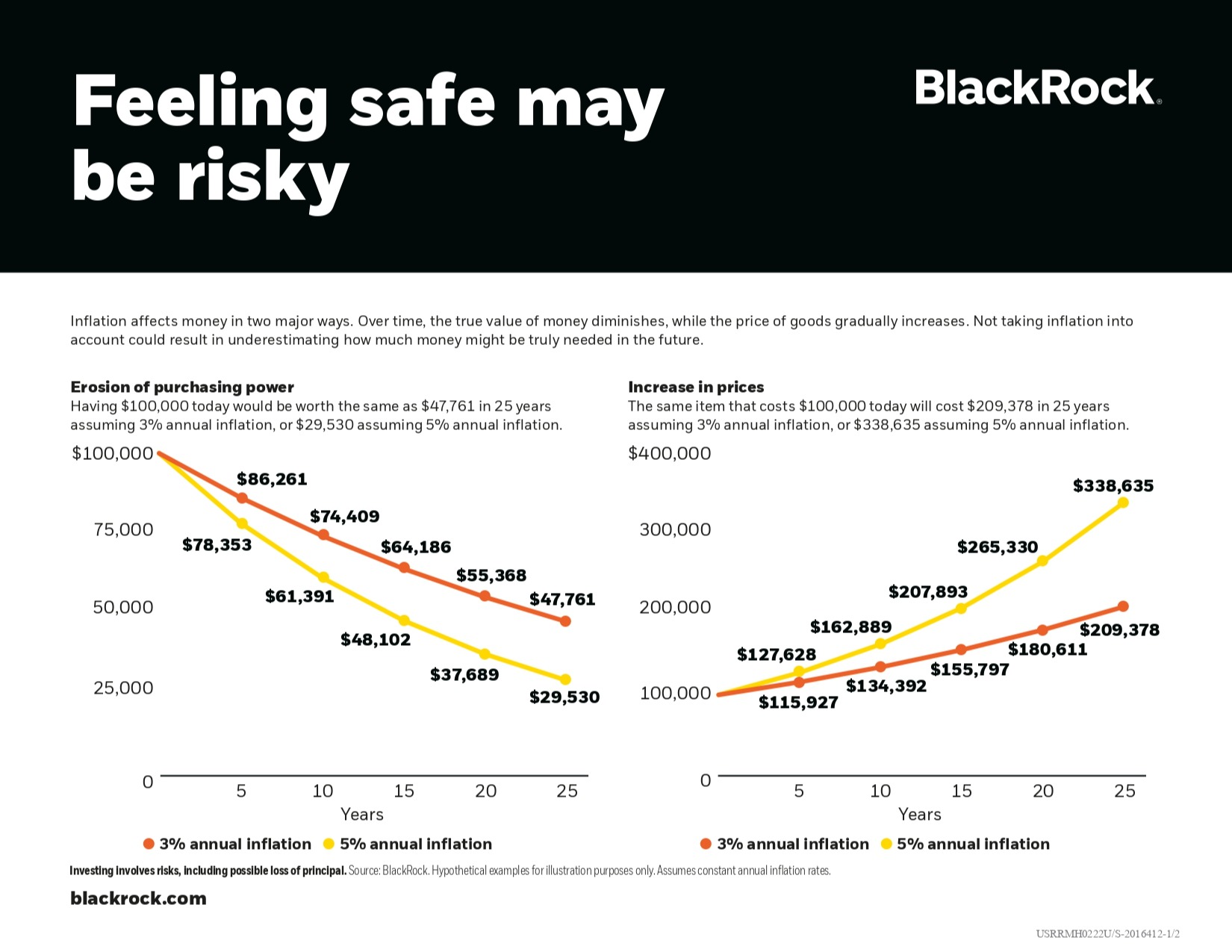
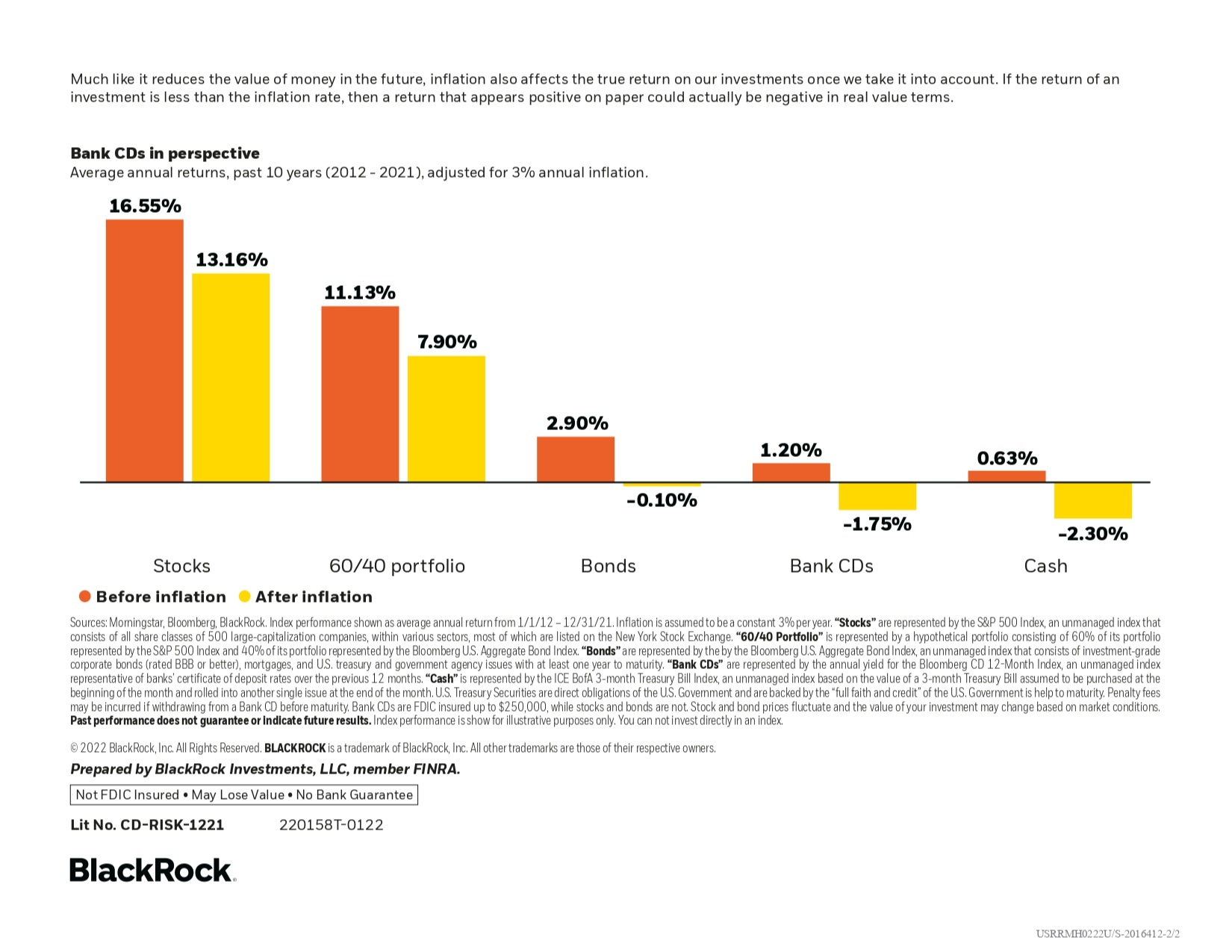
Understanding this fact helps explain today’s difficult bond market environment now that interest rate increases are finally upon us (it was always a matter of WHEN, not IF interest rates would adjust). Inflation in 2022 has risen both further and faster than nominal bond yields, meaning real after-inflation returns are still negative. It’s not too late for cautious investors to consider strategies that could reduce potential bond portfolio price risks above their comfort level.

Annual Returns for the S&P 500 Since 1926
Stocks are often perceived as “risky” assets because price fluctuation occasionally produces a negative annual return, unlike bank savings-type assets. Since 1926 however, S&P 500 Index values have produced positive annual results more often than seven out of every ten years. The issue is that returns over shorter periods vary widely, and can make investors with a too-short time horizon very uncomfortable.
Not only have stock prices risen more than twice as often as they fell during this time period, annual advances of at least 10% have occurred at a rate over four times more frequently than double-digit percentage declines. It’s also important to realize that the S&P 500 is a price-only index that reflects only the price movement of company shares, not the dividend income they produce, which also enjoys a notable record of long-term growth.
Rising earnings and dividends are generated in a growing global economy, and have produced this history of superior historical returns for patient long-term owners of the Great Companies in America and the world. As always, past returns aren’t indicative of future results.

Education, Skills and Your Future
A robust workforce is a key component to America’s long-term success. The first illustration, while focused on educational attainment, applies equally to training in the trades. The likelihood of becoming unemployed holds an inverse relationship to education/skill levels. The second data set shows how closely lifetime earnings track greater educational and skills accomplishments.
Acquiring a stronger skill set or degree is a big commitment of time and treasure, without a guaranteed immediate payoff - something like an investment. Success isn’t assured, and a college education isn’t right for everyone. In a competitive global economy, however, actively seeking better skills and education is the best defense against becoming an easily-replaced commodity employee, or having technology automate your job out of existence.

WHEN You Invest Can Be As Important As HOW MUCH You Invest
Being a diligent saver is clearly a great habit to possess, yet when you choose to begin is a choice. Choosing thrift early in life can reduce a painful need for larger or longer saving/investing commitments (read: lifestyle changes) to catch up if you delay a commitment to build for your financial future. Unfortunately, a late start can also mean that even at higher saving rates you may never overcome the valuable lead of someone who begins accumulation earlier than you.
In this example, investors who choose to delay the saving/investing decision can’t catch up, even when contributing two- to five-times more every month, proving that it’s the early bird who gets to retire sooner.

Watching From The Sidelines May Cost You
Experience repeatedly shows that a choice to sit out of markets during or right after a dip can do much more damage to investor’s long-term wealth than a fleeting correction.
In this illustration of the aftermath of the Tech Bubble (a buying opportunity for the ages), a recovery to the previous highs of 2000 was nearly complete in just three years. Any choice along the way to cash out to avoid further pain risked missing out on a recovery that by 2015 had more than tripled the depressed 2002 lows, with even more substantial advances since. Investors who took advantage of this temporary decline to add to their holdings dramatically sped up this recovery.
Whether the stomach-churning Nifty-Fifty and Go-Go Years, Black Monday, the Tech Wreck, Great Financial Crisis, or the C19 pandemic, it’s clear that large unpredictable setbacks in highly-valued markets happen repeatedly. Declines like these offer an opportunity to either permanently devastate your portfolio, or to maintain and build a more resilient financial future.
As always, the most valuable asset is a long-term perspective.
All investments carry some level of risk, including loss of principal. Dividends are not guaranteed and are subject to change or elimination. Diversification and asset allocation cannot guarantee a profit or avoidance of a loss. Where the potential exists for profit, the possibility of loss is also present. Said another way, past performance is not a guarantee of future results, or as Vince Gill says “There ain’t no future in the past”.

Life Expectancy Probabilities
Life expectancy has doubled in the last century, resulting in a far greater likelihood of retirements reaching 30 years or more. For most Americans this means the time being retired has nearly tripled in three generations, producing higher levels of compounded inflation than those that were ever faced by our grandparents.
This remarkable development challenges resources to grow enough to meet lifetime goals. Many traditional assets struggle to keep up with the growing income demands of an extended retirement, so better planning and advice for reliable lifestyle-sustaining returns is the answer. An experienced professional advisor from The Beck Burchfield Group can help you plan for a brighter retirement.

The Power of Perseverance
Patience can pay large rewards to long-term investors.
In this multi-decade example, S&P 500 index results have produced positive full-year returns in 32 of the 42 full calendar years since 1980, or more than 75% of the time (excluding dividends - price change only). About one-third of the time, a double-digit percentage decline during the year still ended up with a positive year-end result. In every instance, the full-year results were better than the maximum intra-year decline.
For those who avoid rushing into a hot market advance, or who can wait for a price recovery from a temporary market decline, patience is rewarded. These normal, ordinary price fluctuations may also provide particularly attractive asset accumulation opportunities for long-term investors.
All investments carry some level of risk, including loss of principal. Dividends are not guaranteed and are subject to change or elimination. Diversification and asset allocation cannot guarantee a profit or avoidance of a loss. Where the potential exists for profit, the possibility of loss is also present. Said another way, past performance is not a guarantee of future results, or as Vince Gill says “There ain’t no future in the past”.

It’s TIME IN the markets, not TIMING the markets
Avoid the illusion that you can prudently select when to be invested, enjoying only rising market values while avoiding temporary declines. Since markets are always forward-looking in their behavior and often less reactive to current events, market timing is basically impossible.
Market timing attempts to be right both when “selling high” (and prices can get surprisingly much higher), and then again when re-purchasing (when news is bad and values are at their best, this is a very painful decision), and then tries to consistently repeat this feat. Timing also ignores the potential drags of any transaction costs or taxes.
Imagining that you can be right twice, again and again and again, is a fool’s errand. You’ll eventually be wrong, and the results could be devastating to financial health. The fact is that true lifetime wealth develops through long-term accumulation and compounding of primarily equity-based assets, not by employing market timing systems. Patient investors are rewarded as extreme market movements smooth themselves out over longer time periods. As always, investor success is about TIME IN the markets, not TIMING the markets.

The Market Cycle of Emotions
Cognitive biases guide individuals in many ways, but not always positively. A potentially harmful cognitive bias is known as Recency Bias. When investors take emotional actions by giving greater importance to the most recent event(s), by overlooking longer-term trends or more distant occurrences they are exhibiting Recency Bias.
Panic behavior is a Cardinal Investing Sin - preparation is the antidote. Emotional responses are rarely productive, and especially regarding financial issues can be hazardous to your wealth. Panic selling in a market decline is particularly damaging. Instead, investors who recognize the natural progression of market cycles and remain less sensitive to price volatility (both up and down) may be able to capitalize on the generally improved asset valuations inherent in periods of temporary market decline.
Remember, the initial price paid for an investment represents a significant relationship to returns, so an ability to limit an emotional selling response to a temporary market decline can be key to more successful long-term results.

The Early Bird Gets to Retire Sooner
The importance of starting early, and patiently staying with, a program of systematic investment cannot be overemphasized. Consistent investment over full market cycles, especially during periods of slack returns, produces a dominant portion of portfolio results.
Beth, Adam and John are the three young investors in this example. Each invests for a differing period of time, with markedly divergent outcomes. The results are telling, but as expected, taking maximum advantage of time in the markets produces results that can make a major difference in retirement lifestyle.